MCB Trip Curve B, C, D Explained: Ratings, 6000 Marking and SNI
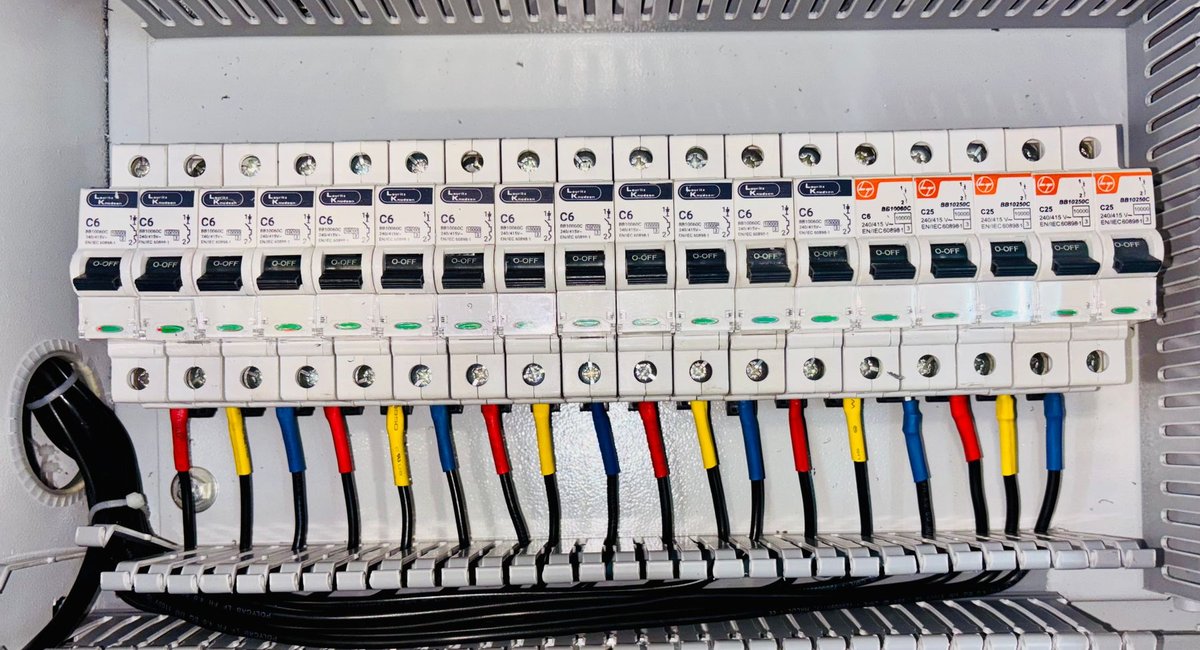
The MCB trip curve B, C or D tells you how much current makes a breaker trip instantly during a short circuit: type B at 3–5 times rated current, C at 5–10 times and D at 10–20 times. For home sockets and lighting, type B or C is the most common. In Indonesia, household MCBs must also meet SNI 8528-1:2018.
Key Facts
- Instant tripping per IEC/EN 60898-1 Table 2: B = 3–5 × In, C = 5–10 × In, D = 10–20 × In (2026-11-02, source: Siemens, SENTRON Miniature Circuit Breakers Technology Primer (accessed 2 Nov 2026)).
- Test currents: no trip within 1 hour at 1.13 × In; trip within 1 hour at 1.45 × In (In ≤ 63 A) (2026-11-02, source: Siemens, SENTRON Miniature Circuit Breakers Technology Primer (accessed 2 Nov 2026)).
- The 6000 marking means a rated breaking capacity Icn of 6 kA; the 3 below it means energy limitation class 3 (2026-11-02, source: Siemens, SENTRON Miniature Circuit Breakers Technology Primer (accessed 2 Nov 2026)).
- Cable rule: Ib ≤ In ≤ Iz and I2 ≤ 1.45 × Iz (IEC 60364-4-43) (2026-11-02, source: ABB, comparison of MCB tripping characteristics B, C, D, K, Z (accessed 2 Nov 2026)).
- Permen ESDM No. 7/2021 requires household MCBs to meet SNI 8528-1:2018 (IEC 60898-1:2015, MOD) (2021-04-01, source: JDIH of the Indonesian Energy Ministry, Permen ESDM No. 7 of 2021 (accessed 2 Nov 2026)).
What MCB types B, C and D mean
An MCB (miniature circuit breaker) has two releases. The thermal release reacts slowly to overload, and the magnetic release trips instantly on a short circuit. The letter B, C or D sets the range of that magnetic release:
- B: 3–5 × In. Siemens calls it universal for socket and lighting circuits.
- C: 5–10 × In. Suited to lamp and motor circuits with higher starting currents.
- D: 10–20 × In. For equipment with high pulses, such as transformers or solenoid valves.
Worked example: a 16 A breaker trips instantly at 48–80 A as type B, 80–160 A as type C and 160–320 A as type D. K and Z characteristics also exist, but they fall under another standard, IEC/EN 60947-2.
MCB trip curve behaviour under overload
For overload, the rule is the same for all types. At 1.13 × In the breaker must not trip within 1 hour. At 1.45 × In it must trip within 1 hour. At 2.55 × In it must trip between 1 and 60 seconds for In up to 32 A. So a 16 A breaker does not cut out the moment the load goes slightly above 16 A.
What the 6000 and the boxed 3 on the breaker mean
The boxed 6000 is the rated breaking capacity Icn of 6 kA, the largest short-circuit current the device can still break safely. The 3 below it is energy limitation class 3. Siemens notes that German homes may only use MCBs of at least 6 kA with energy class 3. That rule does not apply automatically in Indonesia, but it is a useful benchmark.
Choosing the MCB type and cable size
The breaker current must sit between the load current (Ib) and the cable's current-carrying capacity (Iz). ABB gives an example: an S201-B16 at a 6 kA short circuit lets through about 20,000 A²s, well below the 29,700 A²s limit of a 1.5 mm² PVC copper cable. So never raise the breaker rating without changing the cable. If a breaker trips often when a load is switched on, ask an electrician whether type C is a better match.
SNI 8528-1 is mandatory in Indonesia
Permen ESDM No. 7 of 2021 requires MCBs for household and similar installations to meet SNI 8528-1:2018. The scope covers MCBs up to 440 V between phases, rated current up to 125 A and short-circuit capacity up to 25,000 A. When buying, check the SNI mark, curve type, amperage and Icn figure on the breaker. homeX can help source MCBs and panel accessories from several brands for your project.
MCB trip curve: related articles and products
- Switch, socket and MCB prices 2026
- Electrical installation cost per point 2026
- PUIL and RCD guide for homes
- homeX building materials catalog
FAQ
Which MCB type is used in homes? For socket and lighting circuits, Siemens calls type B universal. Type C is used where loads have high starting currents.
Is a type C MCB safer than type B? No. Type C only trips instantly at a higher current, 5–10 × In. The choice depends on the load and the cable.
What does 6000 on an MCB mean? It means a rated breaking capacity of 6 kA under IEC/EN 60898-1.
For building and renovation material needs, reach the homeX team on WhatsApp +62 821 1818 998, by email at homex9998@gmail.com or through our contact page.
Sources: Siemens, SENTRON Miniature Circuit Breakers Technology Primer (accessed 2 Nov 2026); ABB, comparison of MCB tripping characteristics B, C, D, K, Z (accessed 2 Nov 2026); JDIH of the Indonesian Energy Ministry, Permen ESDM No. 7 of 2021 (accessed 2 Nov 2026)